
You have to experience AI to understand it.
Reading and talking about AI is knowing that. Leading with it demands three other kinds of knowing, and they only arrive through doing, in a room, on your own work.
Organisational Architects
For two centuries, an organisation could carry undocumented knowledge, unclear ownership, informal power and contradictory incentives, and still function. Human thinking was slow and expensive enough to quietly absorb the mess. That slack was a buffer.
AI removes the buffer. The moment you put AI on a process, the first thing that breaks is not the technology. It is a handover nobody ever wrote down.
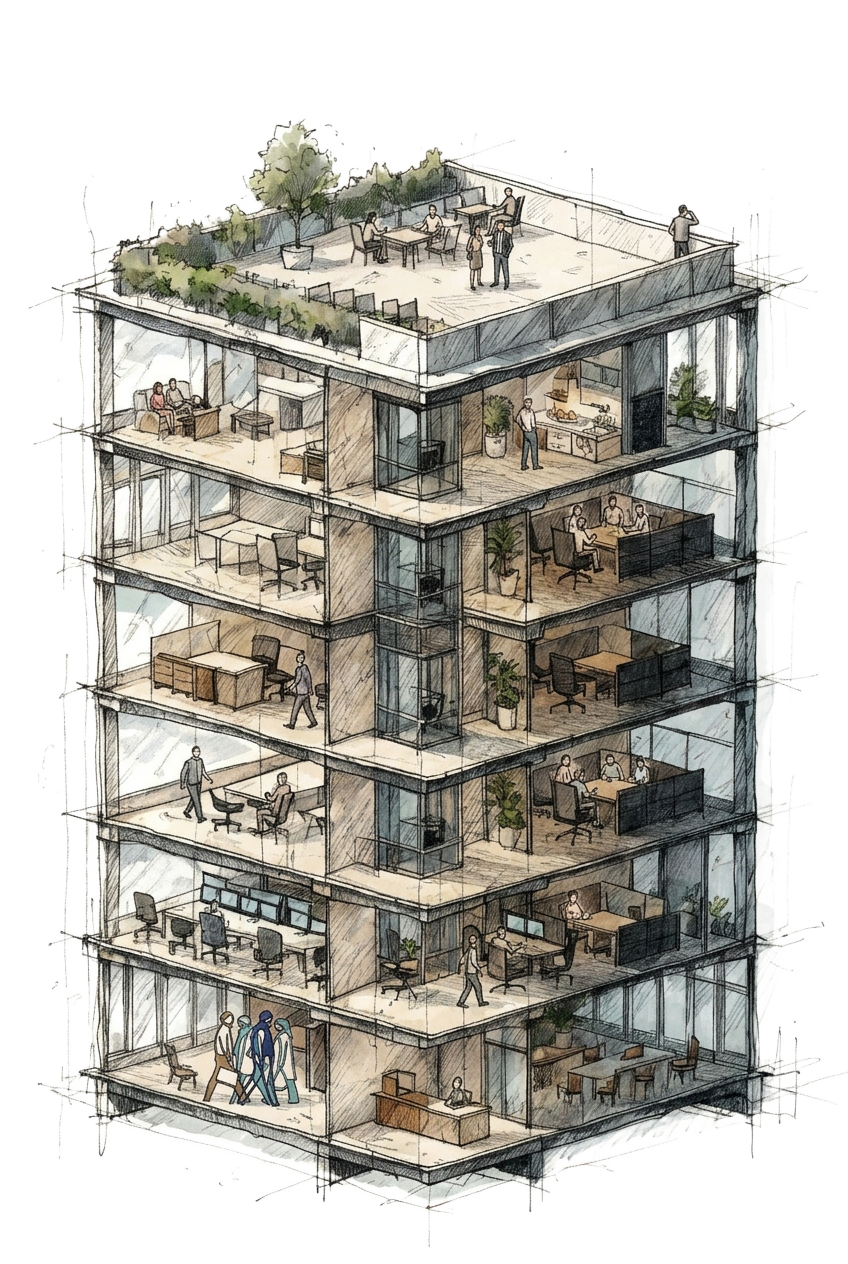
The tacit knowledge lives in the dusty attic. The organisational shadow sits in the basement. The messy middle runs through every floor in between.
The know-how that lives in people’s heads and was never written down. The thing AI needs most, and the thing hardest to reach.
Every floor in between: the assumptions, the quiet workarounds, the handovers nobody ever documented. The first thing AI breaks.
Unclear ownership, informal power, contradictory incentives. The foundations everyone knows are there, and no one names.
This is why the ROI never arrives on schedule: the workflows are undocumented, the handovers are inconsistent, and the knowledge lives in heads. Licences don’t fix that. Access without workflow change is theatre.
What took weeks takes days. Outputs shift from slides to working artefacts. The value of knowing-that collapses, the value of judgment climbs.
Every assumption, every inconsistency, every quiet workaround becomes visible. Psychological safety stops being a nice-to-have and becomes infrastructure.
Structures, incentives, and eventually the employer-employee contract itself. AI is the biggest organisational design question of the decade.
AI changes all three at once. Most programmes address one, and are surprised by the other two.
We are challengers, so we name it. The attic and the basement are there, everyone in your building knows they are there, and with a mirror we can show you. Naming it is the first step to rebuilding it. That is what organisational architecture means to us: not moving boxes, but redesigning how the work, the judgment and the knowledge actually flow.
Three things we hold to be true. Everything we build follows from them.
Reading and talking about AI is knowing that. Leading with it demands three other kinds of knowing, and they only arrive through doing, in a room, on your own work.
Efficiency gains are table stakes. The real why has to be specific to your organisation and central to its strategy, and it cannot be delegated. The original thinking is CEO work: a rallying cry, a manifesto, and eventually a constitution.
Your organisational design, your ways of working, and eventually the employer-employee contract itself. AI runs on your tacit knowledge. But why would your people write down the very know-how that makes them hard to replace, so it can be automated? They won’t, and they shouldn’t, not for free. We advocate skin in the game, on both sides: contribution recorded, recognised, rewarded.
Your why, written down. With skin in the game.
The Constitution goes one step further than most AI principles and governance documents. It answers the question nobody else asks: if documenting your tacit knowledge is what makes AI work, who gets rewarded for it? Skin in the game, on both sides: contribution recorded, recognised, rewarded.
Writes the manifesto. The why beyond productivity, the rallying cry, specific to this organisation and central to its strategy. Original thinking, non-delegable.
Turns the manifesto into the constitution: what we use AI for, what we never delegate to it, and how each level applies it with discretion. Authors it, owns it, keeps it alive.
Build the guardrails, and open with an AI amnesty. Shadow AI is the elephant in every room. Punish it and it goes underground. Declare amnesty, learn from what surfaces, then offer guided freedom inside clear red lines.
A constitution is authored, not downloaded. The document your organisation will actually follow has to be crafted and owned by your leadership team, and kept alive by them. We facilitate that process. You hold the pen.
Clients normally brief the agency. Here we brief you: our stance on what it takes to get real ROI from AI, in one document you can forward to your CEO, OD, strategy or transformation team. The argument, the house, the point of view, and the AI Constitution, on paper, with an executive summary up front.
Zone 07 / Next
Experience the reveal in one day →